Showing posts with label parent communication. Show all posts

Assessment Tips for Distance Learning

As a new school year begins with distance learning, there are so many questions to be answered about assessment logistics and more importantly, accuracy of the results. We are going to be starting our beginning of the year assessments in the coming weeks and I am still unsure of what it looks like. One thing I do know, I need my data to be as accurate as possible. 

assessment tips for distance learning

TIPS FOR GIVING ASSESSMENTS DURING DISTANCE LEARNING


ENCOURAGE STUDENTS TO DO THEIR BEST: Let students know these assessments are to help you teach them this school year. All they need to do is their best work. Scores don't matter. This will lower their anxiety levels too. 


A QUIET PLACE TO WORK FREE OF DISTRACTIONS: This may be easier for some students than others. However, whenever possible, a test taking environment free of siblings, pets, toys, etc. will  help a child focus on the test they are taking online and therefore give more accurate results.


CHECK YOUR TECH: It is important for students, parents, and teachers to make sure they know how to use their technology, especially during assessments. Can multiple windows be opened at once? Do your students know how to click between the different windows? Do teachers know how to share their screen so students only see the test and not where they are marking assessment results? This takes time and practice to set up.


GET PARENTS ON BOARD: Parents need to understand the importance of these assessments. The results need to be accurate, so we can guide our instruction. If parents are prompting, reading, and giving their child answers during the tests, the effort will all be for nothing. Our students have basically missed five months of school. It's pretty safe to say, it should not be the norm to move up five reading levels in that time! In order for there to be a chance for accurate testing results, we need the parents help! I created a list of guidelines to help parents understand the DOs and DON'Ts of how they can help their child during assessments!


I am emailing these guidelines out to my parents just before we start testing. The intention is to inform parents the best way to "help" their children in order to get the most accurate assessment results.

You can gain access to this FREE resource by putting your email into the pop up form that is on your screen when you first come to my blog. You will be emailed a password and gain access to this resource, as well as, many more distance learning resources, which you can download for FREE! Already a subscriber? Just enter the password into the SUBSCRIBER RESOURCE LIBRARY link at the top of the page.

How are you preparing for distance learning assessments? I would love to hear from you!


{DON'T FORGET IT! PIN IT!}


Tips & Freebies for Distance Learning At Home

Considering all that is going on in the world right now with COVID-19, I know most schools have started to implement a digital distance learning platform for awhile. I thought I would put together some online resources I am using with my students and share some strategies I am using with them. 
I have also included some freebies at the end, as well!


It is important to keep in mind that we all have very different student populations. I work at a Title 1 school, but I have many students that have access to technology at home, as well as many students who do not. During this time, our school has made devices accessible for all students by lending them out if parents came to sign for them and pick them up. Also, I know many internet companies, are providing free internet access to students for distance learning. 

 AMAZING ONLINE TOOLS:

PODCASTS
Podcasts are a great learning tool for students to use at home. Choose a podcast for your students to listen to (or have them choose from a variety you give them) and have them fill out a quick podcast brochure to document what they learned. Podcasts are high interest and engaging. They allow students to practice and hone in on those listening skills, while creating independent choice and  allowing them to reflect on their learning. Some favorite podcasts are:
  • But Why? A Podcast for Curious Kids
  • Brains On! Science Podcast for Kids
  • KiDNuZ
  • What If World
  • Story Time


KHAN ACADEMY
Khan Academy is a free site I use to help supplement math curriculum for my students. There are short videos which teach lessons and can be followed up with practice exercises and quizzes. It can be tailored to individual student needs and provides extra practice with concepts taught in class.

NEWSELA
Newsela is a subscription program that is currently FREE during distance learning! It offers meaningful, high-interest non-fiction articles that meet students at their reading level. At the same time, it combines real-time formative assessments with the differentiation your students need to be successful!

VOOKS
Vooks is an amazing online site which brings storybooks to life for children ages 2-8! The library is ever growing and helps students with their pacing of reading, connections between words and text and most importantly, life lessons. Use the link to sign up for your FREE subscription TODAY!

MYSTERY SCIENCE
My students LOVE Mystery Science. Right now, they are offering several free lessons and mini lessons to teachers and parents for use at home during the time of coronavirus. Click HERE to access them.

BRAINPOP
Brainpop is currently offering FREE use during this time. It has engaging videos on various subjects to help teach different topics and skills. You can attach a link to Google Classroom, your district online system, a message or even to an email.

SCHOLASTIC
Scholastic has made many of their resources free for teachers to use during school closures. Make sure to check them out at Scholastic Learn At Home: Free Resources.

Here are 3 FREE resources to help you get started with Podcasts and Distance Learning Norms and Lesson Planning. You can get access to these resources by putting your email into the pop up form that is on your screen when you first come to my blog. You will be emailed a password and gain access to these resources and many more, which you can download for FREE!


{DON'T FORGET IT! PIN IT!}


Homework: What's The Point?

Homework...the dreaded word for so many parents and children.

Why do teachers assign it? Why do kids and parents usually dread it? 

WHAT'S THE POINT? ✎

* Please note: The comments in this post are my opinions solely. They are based on my experiences as a classroom teacher for over 20 years and being a mother of school aged children. There is no hard core research behind my findings, just real world experiences and observations that have influenced my opinions.

This is a blog post I have been mulling over in my mind for quite some time now. I have started and stopped writing my opinions about homework and the positives and negatives about children being assigned work to do at home. It's so controversial. What will people think? Well...no more! Here it goes!

As a parent and teacher, I believe homework should NEVER be assigned as "busy work" for children to complete. It needs to be meaningful and have purpose. The meaning and purpose need to be CLEARLY communicated to the students and parents. I also believe the homework process should NOT take up a large portion of the child's after school time.

I have a middle school aged child, who has 3-5 hours or more of homework every night! It's ridiculous! Then, I have an upper elementary aged child who has 20 minutes of homework a night. Sometimes he doesn't even have any! I think that is ridiculous as well! Finding a balance is difficult, but necessary.

I do, however, believe there are many useful reasons for children to have homework assigned to them. And for the most part, the positives outweigh the negatives.


Teaching children good study habits from a young age is key to their academic success. Providing a consistent, quiet learning environment is extremely helpful, but not always possible. Children also need to learn how to get their work done even when "life is happening around them." Sometimes this is easier said than done. 


My children always know the first thing they do when they come home from school is get their homework started. It is never a fight. They might get a snack to have while doing their work, but they know the work needs to get done before anything else. Now, don't get me wrong, there are days when sports practices or doctor's appointments prevent this from happening. BUT, whenever we get home, they know the homework needs to be completed. 

A consistent routine and expectations for homework help to lay the foundation for good study habits.


Children need to learn to complete tasks within a finite amount of time. This obviously changes with a child's age and school experience. But learning how to manage one's time is a daily life skill that needs to be mastered.

Homework helps students understand and learn these skills. When children have after school activities AND homework to complete, they need to manage their time correctly. This is not a skill they can learn on their own. They need the guidance and support of their parents and teachers to help them understand how to grow their time management skills.


In my classroom, I give my students a weekly homework packet which includes daily homework mini packets that need to be turned in each day. I explain to my students and parents, at the beginning of the school year, WHY I design homework this way. First, I don't want my students sitting down in one afternoon and completing a week's worth of work in one day. Second, I want to give them options if necessary. If on Wednesday, Alexa has dance class until 5:00pm, she can start that day's homework earlier in the week to help reduce Wednesday's work load.

Parents understand and appreciate the flexibility and help their child manage their time.


When my children were starting elementary school, I spent time helping them with their homework. As each year progressed, I did less and less. My husband and I let them struggle a bit. They learn to work through things that don't come to them quickly and easily.


Up until about 4th grade, we checked out kids homework each night. Let's be honest, after 4th grade things take longer to check and the concepts are WAY more complex. You just skim for completion and quality at this point.

If it was messy, they were told to redo the assignment. If they didn't put forth their best effort, we asked them how they thought they could improve. Then they fixed it. By doing this at an early age, both kids learned to work more independently. They were able to gauge what quality work should look like on their own. This carried over into the classroom and hopefully one day, to their jobs.


We have always told our kids, school is their job. It's the one thing they have to focus on and do well. It's their responsibility to themselves and to our family.

Completing a homework assignment, putting it into their backpack, and turning it in the next day to their teacher is CRUCIAL. It's not my responsibility or my husband's responsibility to put their homework in their backpack. It's the CHILD's responsibility!

As a teacher, I loathe the answer to "Where is your homework?" The answer is either "My mom/dad forgot to put it in my backpack" or "I left it at home." And my response is always, "Who's homework is it? Who's responsibility is it to turn it in?" They usually get the meaning of the message quickly.


Homework should be a time to review and practice skills taught in school. It should NOT be a time to learn new concepts they have never been exposed to.

Homework should also be a time when parents interact with what their child is learning in school. 

Look at what skills are being reviewed for homework. Is the homework connected to the standards? Did your child understand what was taught in class? Can you clarify any concepts for your child? 

If you notice your child struggling with their homework or specific skills, reach out to the teacher. If the homework is too easy or it is taking too long to complete, reach out to the teacher.

Homework time should be one of the indicators of how your child is doing in class when you are apart from one another.

Ask questions! Stay connected!


Looking for homework resources? Click the links below for a closer look.


             Spelling Resources


    A Year of Skills in Review: First to Second Grade AND Second to Third Grade


{DON'T FORGET IT! PIN IT!}


Managing Student Learning Goals

As educators, our job is to help our students reach their highest potential. However, not all students are created equal. They all have different needs. Some need to grow academically more than others. Some students need to grow their personal independence. Some just need to get through a period of time on task. And many of MY little sweeties need to learn to tie their shoes on their own!

WHAT'S A TEACHER TO DO?

As educators, we need to help our students work towards achieving goals that are meaningful to THEM! 

How do we tackle this task?

FREE student goal cards

I have always struggled with helping my students set and follow through with individual learning goals. I would usually start off strong and then as the year progressed, it would fizzle out. I would forget to follow through with them and before I knew it the next reporting period had come and gone. 

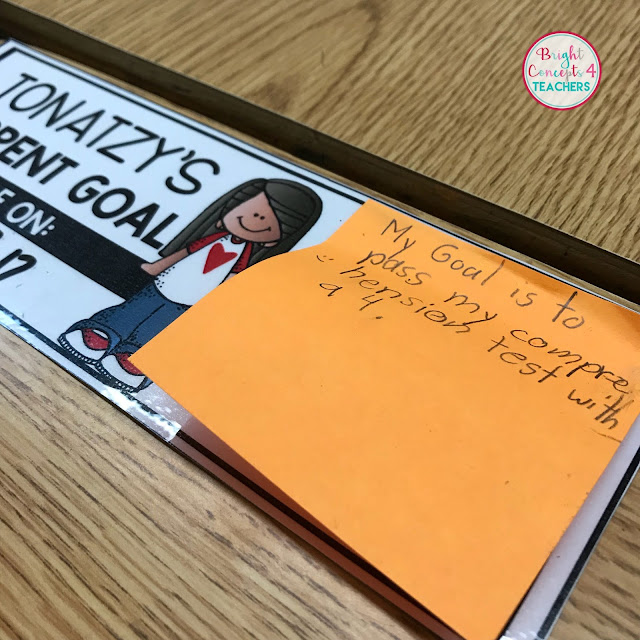
UNTIL NOW.... I saw this great idea, first, on Instagram from @misswestbest. She has her student goals on their name plates. I LOVED the idea but wanted to change it a bit to meet the needs of my second graders. My students have their names on their supply boxes already. I wanted their goal cards to stay at their desks and be a constant reminder for them.

learning goal cards

I know what you are thinking....This is all great, BUT how do I get my students to buy into this? 

1.  GOALS NEED TO BE REALISTIC 

Before we wrote our first goals, we had a class discussion about what a realistic goal would be. Many students wanted to write: "I will get 4s on all my tests." While that is a great goal, it's not realistic. We discussed picking a specific test they wanted to do well on. This narrows their focus and gives them something specific to work towards.

free student learning goal cards

2. GOALS NEED TO BE MEASURABLE

I had to guide and help my students understand this concept. I had students who wanted to write, "I want to do well on my math test." What is "do well?" This little guy wanted to get all his IXL math problems correct. While this is a great goal, I wanted him to feel successful. We talked and decided 85% accuracy was a realistic goal he could achieve. AND...it's measurable.

student goal cards

3. GOALS NEED TO BE CELEBRATED

When my students reach one of their goals, they earn a brag tag to celebrate their accomplishment. They hand me their Post-It note with their goal and the date they met the goal. I put the Post-It on a sheet of paper in their portfolio folder. Everyone claps and cheers for the student! It's an amazing site! Students beaming with pride!

student learning goal cards

Note: After a few weeks of setting and achieving goals, my students were able to manage their goals themselves. They write their goal on their individual white board and put it on top of their desk. This let's me know they need their goal checked by me. If the goal is appropriate, I hand them a Post-It and they write their goal on it and place it on their goal card. I usually adjust or guide my students into a goal that I want them to focus on improving without them realizing it.

There is no pressure to achieve a goal by a certain date. However, if I see a student hasn't met a goal in a few weeks, I ask them to rewrite it or make it more realistic and measurable. I want them all to feel success within a reasonable amount of time.

Ready to get started? Grab your FREE set of learning goal cards by clicking: HERE.
*Please note: You must have PowerPoint to open and use this file.

I love to hear from my readers. Leave a comment and share how you help your students manage and set their learning goals too.

{DON'T FORGET IT! PIN IT!}


Back To School Ideas

Back to school classroom ideas

Back To School is in full force! And we all know, there is no tired, like teacher tired during the first month of school. I am going to share a few time saving tips with you that will help ease your stress levels and help you relax a bit during the beginning of the school year.

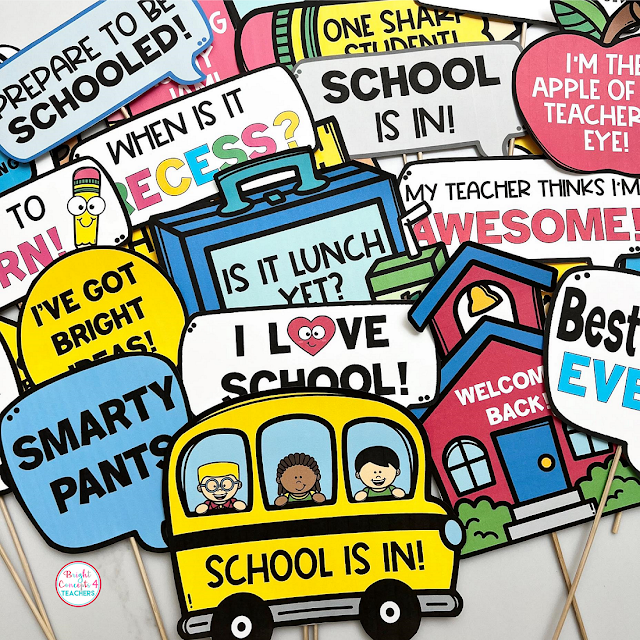
I love to create a sense of classroom community starting with the first day of school. I always take a first day of school picture of my students to send home to families right away. Creating memories and making the first few weeks of school unforgettable for students is crucial to fostering those new relationships. These photo booth props are also a fun activity for students and their families for: 
Meet the Teacher
Back To School Night 
Open House 
and the First Day Of School! 

Back To School Ideas for the elementary classroom

Are you required to post student learning standards each day? I was spending WAY TOO MUCH time writing the CCSS out on the board each day. It took up valuable learning space on my board and I was getting frustrated. To solve this problem, I created kid-friendly standards posters I could change out easily and quickly in a pocket chart. The front of each card has the standard, in kid-friendly words. The back of each card, has the actual standard written out with the standard number and strand. These are available for all the ELA and MATH standards grades K-5. Now, when I have my admin, a parent, etc. come into our classroom, they can easily see what skills we are working on throughout the day.

Easy to use student friendly standards cards in kid friendly language make switching standards out so much easier.


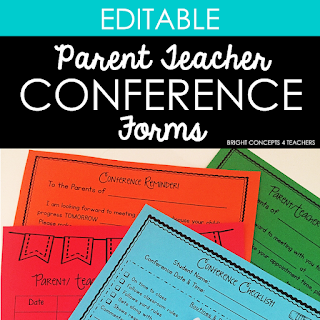
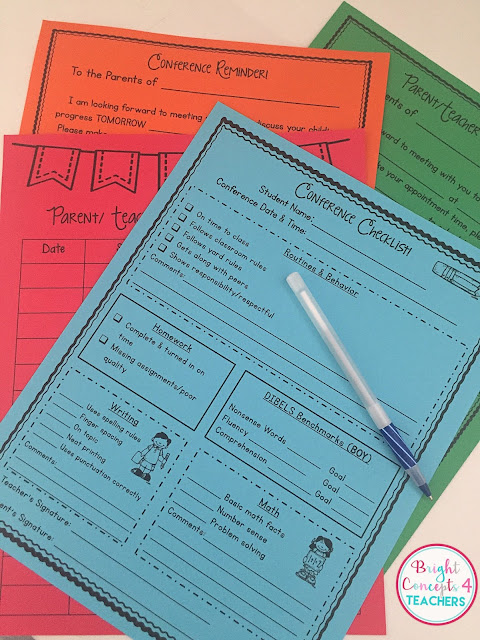
Do parent conferences stress you out? Do you hate prepping for them or don't know how to organize all the information you want to tell them in 15 minutes? I have the resource for you! Getting organized for conferences has never been easier, since I started using this personalized conference binder. It has all the forms and information I need at my fingertips. 

Conference Forms

All the forms are editable, which helps save time too! This pack includes:

1. A conference note to send home with the date and time of the meeting. 
2. A reminder note
3. Sign in sheet
4. Missed You At Our Conference note
5. FIVE conference checklist options
6. Personalized binder cover


I love to use these editable parent teacher conference forms to help make conference run smoothly.


This is, by far, a new favorite in my classroom! Be the coolest teacher on campus with this Back To School bulletin board. Bridging the gap between school and social media will make you a hit with your students and their families. Each student will create their own Instagram page with a personalized picture, comment, and hashtag. This is a great student center bulletin board that you can leave up all year! I emailed the parents and asked them to email a picture of their child doing a favorite activity, on a summer trip, or just hanging out. They kids were so excited to see their faces up on the board as each picture was sent in. It is a great motivator and they love reading what each caption says.

Instaclass back to school bulletin board


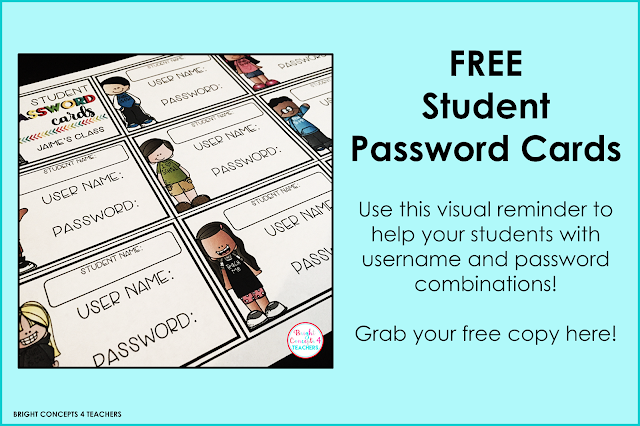
Do you get frustrated always having to stop your teaching to help a student log on to a website? Are you looking for a way to organize their user names and passwords? I have the resource for you! And the best part....it's FREE!

I was getting so frustrated every time we went to computer lab and I would always have several little kiddos tell me they couldn't log on to a site because their password didn't work. Nobody has time for that!  To solve this problem, I created individual student password cards! This was a game changer for me. Just write the student's name, user name, and password on the card. Then, laminate them and hole punch so you can put them on a ring. Each time I go to the computer lab, I grab the appropriate password ring and off we go. Ta Dah! Problem solved! Grab your freebie below:

Back To School Ideas


I hope these back to school tips have given you some ideas that you can use in your classroom. Best of all, you can start implementing them immediately! Enjoy!

{DON'T FORGET IT! PIN IT!}


Back To School Ideas

It's hard to believe it is already Back To School time! Where did the summer go? Now it is time to gear up for an incredible year ahead! I've got you covered with some of my favorite beginning of the year resources.

A FEW OF MY FAVORITE BACK TO SCHOOL ITEMS:

1. INSTACLASS: Be the coolest teacher on campus with this Back To School bulletin board. Bridging the gap between school and social media will make you a hit with your students and their families. Each student will create their own Instagram page with a personalized picture, comment, and hashtag. This is a great student center bulletin board that you can leave up all year! I can't wait to get into my classroom and start gathering pictures from my students so I can get this board up right away!

personalized classroom bulletin board

2. BACK TO SCHOOL BASICS FORMS: I like to have all my students' information at my fingertips. I never know when I am going to have to contact a parent, look up how a child gets home, discover food allergies, and more! I love using these forms to keep the lines of communication open with my families. 

parent communication forms


3. STUDENT PASSWORD CARDS: How many times have you gone to the computer lab, only to have a couple little darlings tell you their password doesn't work. Hello??? User error!!! Nobody has time for that. I created individual student password cards to solve this EXACT problem. Just write the student's name, user name, and password on the card. Then, laminate them and hole punch so you can put them on a ring. Each time I go to the computer lab, I grab the appropriate password ring and off we go. Ta Dah! Problem solved! You can grab this FREEBIE by clicking HERE.

free student password cards for students

4. BIRTHDAY BLOOMS: I love to celebrate birthdays in school, but with 24+ little kiddos, it can get very expensive. At the beginning of each school year, I create our class Birthday Blooms. I attach the "flower" to a special birthday pencil and create this display. When it is a child's birthday, they get to pick out their pencil, get a birthday sticker, and a homework pass. It's very low cost. Each child feels super special and it makes an adorable display. You can grab this FREEBIE by clicking on the picture below.

birthday flower pencils for students