Parent Conference Tips & Tricks

I survived! Yes, I really did. I just wrapped up two full weeks of parent‑teacher conferences. Two weeks. I know that sounds wild, but hear me out — because there’s a reason I do it this way, and why I’ve actually come to look forward to conference time.


I’ll be honest: I used to dread conferences. Not only did I have to finish every single report card (which we all know takes HOURS… sometimes DAYS), but then I’d sit down with each family and basically reread the entire report card to them. I hated that routine. It felt repetitive, stressful, and honestly not very meaningful. Something had to change.

So our school shifted the process: We meet with parents before report cards go home. That means no surprises for families and a much more productive conversation for everyone involved.

I schedule my conferences across two weeks, and each one is just 15 minutes. Yes — 15 minutes! It’s absolutely possible to keep things personal, focused, and helpful within that time frame. And spreading them out keeps me sane. Instead of cramming 10 conferences into one day and feeling rushed, I usually have 2–3 a day. Some days I have more, some days none at all, but the spacing makes a huge difference in my stress level. 

To streamline everything, I created a conference binder that holds every single thing I need. No more scrambling for forms, rewriting notes, or digging through piles on my desk. Everything is organized, accessible, and ready to go.


And this form — THIS ONE RIGHT HERE — is the best thing that ever happened to my conferences. It’s a simple checklist with space for quick notes, and it takes about five minutes to complete. Five minutes! Yet it gives a clear snapshot of what’s happening with each student both academically and behaviorally. I make a copy for parents so they can jot down notes, and I keep one for myself. This checklist is the heart of our conversation.


I also use a conference reminder form to help cut down on missed appointments. All my masters and copies live in plastic sleeves inside my binder so I can grab them instantly.


I keep a sign‑in sheet for documentation — one copy for me and one for my admin. And if a parent signs up but doesn’t show, I send home a quick “missed conference” note. I don’t need it often, but it’s nice to have ready.


Grab your editable conference binder pages HERE:

parent conference forms

Get your conferences started off in the right direction with these forms. Click on the picture below to grab your FREE copy. 


Once everything is organized and in one place, conferences feel so much more manageable. Truly. Having a system gives me confidence walking into each meeting, and it helps parents feel supported and informed.

I hope these tips help you feel ready to tackle your own conference season head‑on. You’ve got this!


Candy Corn FREEBIE!

Super quick post tonight. I wanted to share a fun little freebie with all of you.
We are finishing up our review of singular and plural nouns this week. I wanted a quick assessment I could use to also display in our classroom. A few minutes later these little guys were born! HA!

Each student chose a noun. The noun could be regular or irregular. Then, they wrote the plural of that same noun. 

Finally, they used the plural noun in a sentence. Some students chose to write two sentences using the singular and plural form. When they were done, they cut it out and we put them up in our classroom!
Grab a copy of this freebie activity by clicking HERE! Enjoy!

Scarecrows and Pumpkins: Time for Fall

I am SO excited that October is finally here! It is my favorite season! The weather is still very warm here, but sweaters, boots, and scarves are on the horizon, my friends! As soon as it is humanly possible, I bring Fall into my classroom.


 Last week, I introduced acrostic poetry to my students. I started off by reading one of my favorite fall stories.

This got my kiddos hooked! Then I introduced how to use a thesaurus. The kids worked in pairs to come up with words that described a scarecrow. Next, we made a chart of all the words and phrases that described a scarecrow using the letters in the word. 

After we wrote our poems, it was time to build our scarecrows!


The kids took so much pride and ownership into following the directions and building the perfect scarecrow. Too darn cute! I don't have a lot of bulletin board space, so here are their scarecrow masterpieces hanging from the ceiling. You can find all the scarecrow templates and writing ideas in my Scarecrow Craftivity and Writing Prompts pack.


I also did my first directed drawing lesson of the year with my kiddos. I was looking on Pinterest and found this little gem. When I went to the website, it did not take me to the actual lesson. I hunted around, but I used the pinned picture for directions instead because I needed to make a sample before the kids came into the classroom and time was running out! 
Step 1: We used pencils to sketch the drawing step-by-step. This allowed for mistakes to be erased, since this was their first drawing of the year. Then, we used black felt tip markers to trace over our lines.

Step 2: I showed the kids how to shade using different colors of yellow and orange.


Step 3: Color the background sections using solid colors or with patterns. We used crayons this time. Oil pastels and water colors would also be great to use.


I mounted them on black paper so they would POP! Viola! I think they turned out marvelous!


I love these lessons because it forces my students to listen and follow directions. It helps them with their fine motor skills and introduces them to different types of art and art mediums. They are so proud of themselves when they are done. This will be the first piece that goes into their art portfolio for the year! 

Making Math Fun!

MATH... Oh, how I love thee! I am super excited to be linking up this month with some fabulous bloggers to bring you tons of fun math strategies and games.
I love to teach math. I am always looking for new ways to engage my students and get them to embrace the new ways of the Common Core strategies and how to explain their thinking. This can be so difficult for so many students. They can tell you that 10+2=12 but they can't tell you why. Well, those days are over in my classroom! I always tell them, I don't care what your answer is, I want to know HOW you got it. PROVE IT!  

1. MATH CRAFTIVITIES:
Anytime I can incorporate math and a craft, I DO IT! We just finished up our addition and subtraction strategies unit. I wanted my students to PROVE they learned the strategies I taught them. I used this little craft to bring fall into our classroom AND have them review their addition strategies. 
You can use this template to incorporate whatever math strategy your kiddos are working on at the moment. Students can show how to make 10, fact families, arrays, skip counting etc.  It just brings a bit of fun into your math lessons. The kids don't realize they are working on math and they tend to be more focused and proud of their work. 

Click the picture above to grab your {FREEBIE} copy of this activity to use with your students too.

2. INTERACTIVE MATH NOTEBOOKS
One of my favorite math strategies, that is always a home run with my students, is to use INTERACTIVE notebooks. My students squeal with delight when we work in our interactive notebooks. I don't think they actually realize they are using their math knowledge when we are creating pages in our notebooks. 
I love the activities because they are perfect for independent practice during math centers. During center time, I always have my students review concepts I have previously taught. This gives them a chance to review and practice what they know. 

We also use our notebooks to  work on problem solving skills. Each problem solving page asks the students to identify what is being asked in the word problem, draw a picture to show their thinking, write a number sentence and the answer. However, what is MOST important about the word problem pages, is an explanation of HOW they solved the problem. I love this part because it makes my students think and explain. When they can do that, they are more likely to understand and retain the concept being taught!

Are you ready to get started with interactive notebooks? Check out this FREEBIE sampler with a few activities that will get your students engaged and excited about math. 

Sight Word Activities for Beginning Readers

sight words


Let's face it... sight words are tricky! Kids struggle learning them and we struggle finding fun and creative ways to get our students to learn them. It doesn't matter what grade I teach, first, second, or even fourth grade....I always have students who are struggling with their sight words.

Every school year I have a group of students who know their sight words like the back of their hands. But the majority of my students struggle with them. Maybe they can read some of them, but they can't always spell them. Some are even still trying to sound them out, which we know is not possible for many reasons. They have to know them by sight, with automaticity, in order to become strong readers. 

I like to start my school year, reviewing sight words the students should know from first grade. This is a quick assessment for me. It is just one tool I use to help me gauge where my students' skill levels are when they come to me. After I test them, I give them flash cards with the words they need to still learn. I love these flash cards because they have the word written in letter boxes for the students to visually see how the word is written.  This strategy helps many of my struggling learners. 

sight word practice

how to teach sight words

Learning and reviewing sight words can be so dull and boring. I want my students engaged! I have created several ways of doing this. One way is to focus on a small number of words at a time. Four or five words seems to be the magic number for most of my kiddos. 

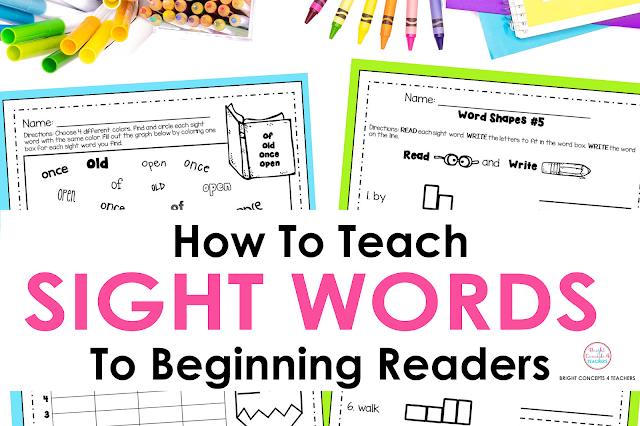
This activity helps the students recognize sight words in different fonts, sizes and shapes. Once they identify the words, the students graph how many times they saw each word. 

sight word practice for beginning readers

sight word no prep resources

sight word resources

I also like my students to see the sight words in text. I created fluency and cloze reading passages for this reason. Students need to see the words in context, not just in isolation in order to remember, retain, and use the words correctly. 


Are you ready to use some of these activities in your classroom? Try them out for yourself. This {FREEBIE} BONUS pack of activities is just for you. 


{DON'T FORGET IT! PIN IT!}